 Science
The "Blob" – A Single-Celled Organism with 720 Compatibility Types That Learns Without a Brain
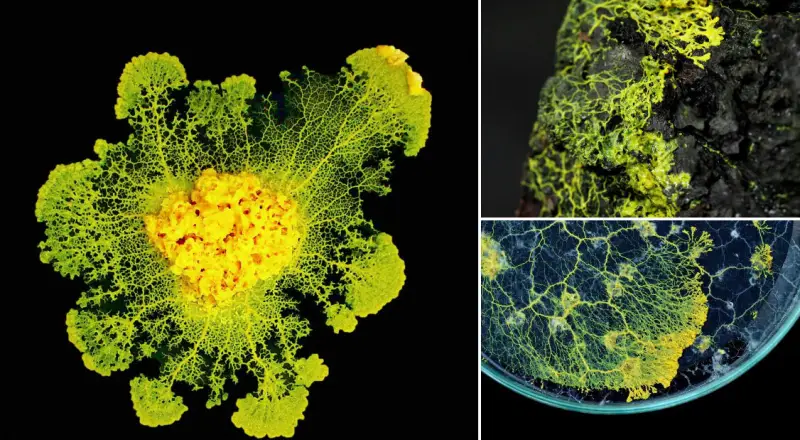
In October 2019, the Paris Zoo presented the public with an unusual exhibit – a yellow slimy mass nicknamed the "blob". Behind this striking name hides Physarum polycephalum (also known as Badhamia polycephala in newer taxonomic databases) – a slime mold that is forcing scientists to rethink their understanding of biological intelligence.
What is this organism
The blob is neither an animal, nor a plant, nor a fungus. It is a representative of the Amoebozoa group. In its active stage (plasmodium), it is not a colony of cells, but one giant cell with thousands of nuclei united by a common cytoplasm. It has no brain, nervous system, or sensory organs, but it moves at a speed of up to 1 cm per hour thanks to rhythmic cytoplasmic flows.
720 types of compatibility
The most widespread myth is that the blob has 720 sexes. In 2026, Professor Marc-André Selosse from the National Museum of Natural History in France officially refuted this formulation. In reality, we are talking about 720 types of genetic compatibility. They are determined by the combination of alleles at three loci (matA, matB, matC), which allow microscopic cells to fuse. The slime mold does not have a conventional division into male and female individuals.
How it learns without a brain
Scientific experiments have confirmed several forms of adaptation in Physarum:
- Habituation. In 2016, scientists proved that the blob stops avoiding harmless but unpleasant substances (such as caffeine or quinine) if they are encountered repeatedly on the path to food.
- Spatial memory. As it moves, the slime mold leaves behind a layer of extracellular slime. This serves as its "external memory": it avoids already explored zones, which helps it navigate mazes efficiently.
- Transfer of "knowledge". In 2017, it was proven that when two plasmodia fuse, an untrained organism adopts the habits of the trained one, ignoring previously avoided obstacles.
Famous experiments
In 2000, Japanese scientists placed a blob in a maze with oat flakes at the exit. The organism quickly found the shortest path, with dead-end branches of the network dying off. In 2010, researchers recreated a map of Tokyo on a Petri dish, placing food at the locations of the stations. The slime mold built a network of connections that, in terms of efficiency, cost, and resilience to failures, proved comparable to Japan's real railway system.
Resilience and space missions
The blob can quickly regenerate a damaged membrane, and under unfavorable conditions (drought), it turns into a hard sclerotium capable of waiting for moisture for years. In 2021, French scientists sent samples of Physarum to the ISS with astronaut Thomas Pesquet to study the effect of microgravity on its spatial navigation.
Scientists debate whether this can be called "intelligence". The blob does not think in the human sense. However, it demonstrates that complex adaptation, route optimization, and the simplest forms of memory are possible through local physicochemical processes within a single cell, without a single neuron.